Sunday, February 1, 2015

Welcome to the winter 2015 edition of eMuse!

In this edition...

Read more!

The Summer Community

Bill Tucker, Director

Make no mistake: the Writing Teacher’s Leadership Institute is a close relative of the Summer Invitational Institute of bygone years, but it has evolved into a variety of the species. Now everyone (even alumni/ae) is invited, demonstrations are planned and performed in teams, duration is condensed to three weeks, and teacher leadership is a prominent theme. Because we had two SI veterans attending with the first-timers in 2014 and because we had a stream of seven of our own teacher leaders describing their leadership roles, we have begun to think of the summer institute as a leadership community.

Teachers are now coming to the summer institute to find their niche in leadership: as writers and advocates, as consultants in writing, as classroom researchers, as school improvement leaders, as literacy coaches, and as family literacy presenters.

One other difference: the free institute has gone the way of the hula hoop (oops, the hula hoop is not dead, if you ask Erin Umpstead). This summer you will pay $1950 for three graduate credits or $750 for state clock hours. As I predicted, 2014 was the last summer of the free ride.

The dates? June 29 - July 17, 2015, 9:00 a.m. – 3:00 p.m., Monday- Friday, (Campus Closed Friday, July 3, 2015). The location? EMU Student Center 320. That has not changed.

It is not too early to approach your principals or department heads about subsidizing your vacation, er. . . professional development. The familiar application is attached, but the experience will be novel and inspiring. We promise!!
Read more!

Literacy for Life: the Best of Teacher Leadership

Bill Tucker, Director

The best teacher leader models are coming your way this spring. Four sessions on Saturday mornings in Pray-Harrold show how timely and inventive our teachers can be.

In February you'll find what teachers have learned about advocating for their own profession from a workshop last summer. Cathy Fleischer will keynote a group that includes Lisa Eddy, Erin Umpstead, Kris Gedeon, Lauren Nizol, Beth Shaum, and Jeff Taylor. Meanwhile Michelle Vanston will continue her highly practical series on implementing a reading-writing workshop with Making Writing Partnerships Work (see attachment).

In March the Special Education Inquiry group will be led by Professor Rhonda Kraai, a specialist in Cognitive Impairment. This group, including Karen Hoffman, Dawn Izzi and Judy Wycoff, will focus on case studies of individual students who required special interventions in writing.


April brings a focus on digital writing, echoing Troy Hicks' presentation at the Literacy Summit at the WISD April 23. Karen Chichester and Michelle Vanston will bring the latest applications for digital writing for all grades K-college.

We'll finish the year in May with our annual Google workshop, helping teachers implement useful applications from Google-forms.

See the links to announcements and the Spring schedule for details. Don't miss this showcase of the best teacher leaders in southeastern Michigan!
Read more!

Graphic Literature Interactive Workshop

Pam McCombs

Would you like to incorporate the sequential-art-narratives of comics and graphic novels into your teaching? Well join four EMWP fellows, K-13 writing instructors this June 24-26. In this interactive workshop you will be immersed into activities that introduce you to visual literacy, and get you reading and writing comics with the ultimate goal to create your own sequential art memoirs.
Through reading and discussing various resources on sequential-art-narratives, participants will gain a complete understanding of the value comics and graphic novels can hold within our classrooms. Sources to be used:
Read more!

Digital Tools and Techniques for Literacy Instruction

Karen Chichester and Michelle Vanston

Technology has changed our classrooms. Schools have gone Google. Students are bringing their own devices to class. Chromebooks and iPads abound. So, how we can incorporate these into our literacy instruction? Join an elementary teacher and a secondary school teacher for three days of hands-on use of technology from June 17-19.

In this workshop, we will immerse ourselves in digital technology and examine best practices for their use in the classroom. We will use student artifacts, our source texts and online resources to guide our discussion, experimentation, and collaboration. By the end of our third day, participants will have new resources for classroom use, a better understanding of technology best practices, and have revamped one lesson or unit of study to include technology.

For source material, we will use


Facilitators: Karen Chichester and Michelle Vanston, EMWP Teacher Consultants.
Read more!

Saturday, January 31, 2015

Telling Our Stories/Raising Our Voices: From Anecdote to Action
An Eastern Michigan Writing Project Summer Institute
July 20-22, 2015
9am – 3pm each day


Cathy Fleischer, EMWP co-director

Sadly, the ongoing conversation about school reform too often leaves out the voices of teachers—those who are most intimately acquainted with the day-to-day issues that impact students and their learning. We believe that these voices are essential ones for policy makers to hear, but we recognize as well the pressures on teachers to remain silent.

How can teachers safely enter the conversation? In this workshop, we’ll help you become part of that conversation as you learn how to develop your personal stories into a more public narrative, starting from anecdotes and building toward an action plan. By the end of day 3, you should have an action plan to take back to your classroom and school.

The workshop is facilitated by Dr. Cathy Fleischer, EMWP co-director and author of Teachers Organizing for Change. Applications will be sent to all EMWP Teacher Consultants in February. For more information, contact Cathy at cathy.fleischer@emich.edu.
Read more!

Family Literacy Initiative Training Institute

July 23, 2015
9:00 a.m. – 4:00 p.m.


Kim Pavlock

EMWP’s Family Literacy Initiative has offered more than 200 workshops to more than 4,600 participants since 2006, helping parents and families understand how they can support their children and teens as writers. We present in schools, churches, and non-profit sites and have developed twelve separate kinds of workshops. Response has been overwhelmingly positive to these workshops, and they have become a hallmark of our NWP site.

Are you interesting in learning how you can develop a similar family outreach program at your site? Join us on the campus of EMU for a day-long institute focusing on what we do, how we do it, and what we’ve learned over the past nine years.

Cost is $75 (which includes breakfast and lunch). To reserve a spot, contact Kim Pavlock, EMWP Youth and Family Programs Coordinator, at kpavlock@emich.edu.
Read more!

Family Writing Fun Night!

National Writing Project tagged Eastern Michigan Writing Project in a Facebook post:

Posted by National Writing Project
January 29 at 2:48pm
Check out this great gallery of photos from Family Writing Night hosted by teacher-consultants from the Eastern Michigan Writing Project: http://bit.ly/1wERJhK:

Mitra Dunbar, lecturer at EMU, is pictured here.

You can read more about Family Writing Fun Night and see more pictures here.
Read more!

EMWP Partners with Litchfield Elementary on Major Federal Grant

Sarah Lorenz, Director of Professional Development

The Eastern Michigan Writing Project was honored to be selected as the primary external service provider for Litchfield Elementary School’s School Improvement Grant in 2014-15. School Improvement Grants (SIG) are a major initiative of the U.S. Department of Education, and they provide priority schools with the opportunity to submit competitive grant applications for funding to assist their school turnaround efforts. Litchfield is a rural school district in Hillsdale County, about an hour and a half from Ypsilanti. They were elated to receive a 1.3 million dollar SIG this year, which will fund technology improvements, coaching, student interventions, and professional development.

EMWP’s role is to provide intensive professional development and family literacy programs for Litchfield. We have already begun with a concentrated program focused on guided reading for K-5, with a goal of 60 days of embedded professional development by July. Teachers have received multiple days of training in guided reading, while their students were engaged in an enrichment program taught by skilled NWP teacher-consultants. Teachers and school leaders were also welcomed for observation visits arranged by EMWP in another school with a long-term commitment to guided reading. Demonstration lessons and classroom coaching are being provided by EMWP TCs and EMU faculty. Teachers and students have been delighted to receive new leveled libraries to support the guided reading work. Programming slated for spring, summer, and next fall includes family literacy workshops, digital literacy, writing camps, and writing instruction. SIG schools are eligible to apply for a second and third year of funding, so EMWP is working with Litchfield to strategize for quick gains in reading proficiency as well as a long-term master plan that will impact reading, writing, science, and social studies. We will be calling on the EMWP network of teacher-consultants to further support this work in the coming months. Read more!

DePaul Students Explore and Blog About Chicago Yoga

Natalie Tomlin, TC

During last year's holiday break, I proposed a new course for DePaul University's first year experiential learning program entitled "Exploring Chicago's Yoga Community." Designing and later executing this course in the fall of 2014 was the meeting of my two passions: writing and yoga. I have been teaching yoga since 2012 and have been practicing around Chicago since 2010. Since the experiential program focuses on getting students familiar with Chicago, as part of the course, I planned 5 excursions around the city, where students would practice together and interview teachers and studio owners. I envisioned the course as not just a passive tourism of yoga in the city but rather a journey informed by a critical lens. Therefore, I adopted a core text, entitled 21st Century Yoga, which is a compilation of mostly bloggers presenting different points of view on contemporary yoga.

And because the critical conversations about yoga most often start online, I thought it logical that my students were to create their own blog as part of the class! I knew that their writing would be interesting to the online community, so my own ambitious goal for my students was that they share their work on our course page, and several took me up on that: https://chicagosyogacommunity.wordpress.com/. After the conclusion of the course, I received the news that a magazine was interested in publishing my student's work: http://yogachicago.com/2015/01/doing-it-for-the-savasana-exploring-yoga-in-chicago/.

Although I am not sure yet if I will teach the course again in the fall, I have been invited to contribute to a workshop on experiential learning at the 2015 Conference on College Composition and Communication in Tampa.
Read more!

Professional Development Updates (Part 2 of 3) 
For All Those Data-Lovin’ Hearts...

Sarah Lorenz

Click here to read Part 1

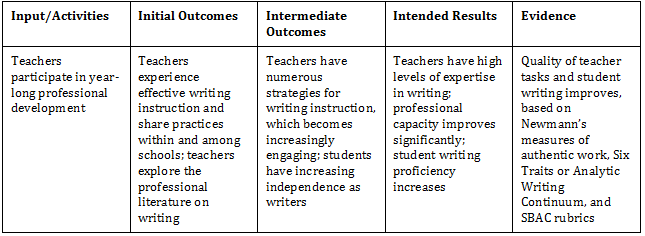
Sample Theory of Action Strand:

Sample Problem of Practice:
An affluent suburban elementary school has many positive features, but the principal and teachers have identified writing as an area needing improvement. While there are many talented teachers using a wide variety of excellent resources, as well as a general commitment to a writing workshop format, the program lacks cohesion and test results in writing are just so-so. No one is quite sure if students are receiving a comprehensive, progressive course of study in writing.

With many high-achieving students and some English language learners from professional families, teachers are challenged to meet a wide variety of needs. Some teachers are concerned about their lack of training to teach writing, and others worry about a loss of autonomy when moving to a common curriculum. Everyone agrees, however, that it is time to work together to collectively raise the professional knowledge about writing, map out a defined plan both vertically and horizontally, and create true synergy in the teaching of writing.

As part of this planning framework, we can then collect survey data after every PD session—did the work today hit the target? Is this the right target? What worked, and what didn’t? I’m still experimenting with the best method for collecting this data—I’d like a digital format as opposed to the old paper sheet. I’ve tried Poll Everywhere, which is quick, but I don’t really want all the responses up on the screen. SurveyMonkey isn’t as easy to do on a phone, so some people don’t participate. Suggestions are welcome if you have other solutions.

To be concluded in the next edition...
Read more!

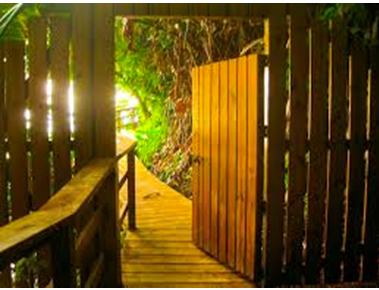
Turn around, So You Can Find the “Open Door” and the Rest of Life

Jim Schaefer, TC 04

    As I work with my students and their writing, a frequent pattern in their search for meaning is the discovery of closed doors that seem to be preventing them from fulfilling their dreams. A complex array of situations exist for them in their own lives, but the level of intense frustration, even anger, exists as they struggle to resolve their dilemmas.


Parker J. Palmer, known as one of the most influential senior scholarly leaders, offered a possibly soothing bit of insight in his book, Let Your Life Speak: Listening for the Voice of Vocation. Palmer noted that when a “way closes behind us, it is tempting to regard it simply as the result of some strategic error” that we may have made (p. 53). Palmer suggested that instead what may be happening is that this closing “may reveal our limits,” while the opening “may reveal our potentials” so that “the rest of the world opens up” (p. 54).

    I’ve heard of the saying that when one door closes, another opens up, before, but I’ve never thought about the reaction that Palmer suggested. Instead of “pounding on the door just closed,” Palmer urged people to “turn around—which puts the door behind us—and welcome the largeness of life that now lies open to our souls. The door that closed kept us from entering a room, but what now lies before us is the rest of reality” (p. 54).

    This wonderful insight applies not only to vocational challenges that so many people, including students and educators, face but also to the journey of discovery in writing an essay. Just recently, one of my students in a class on writing academic research essays was frustrated in trying to understand a specific exchange with her mother, and when I worked with her, she finally understood that what had happened was within the larger context of a mother-daughter relationship. It was a very meaningful epiphany in many ways for her.

    I personally think that there are many times in many situations when we need to allow ourselves to turn around (get a different perspective) so that we can better understand and react to what is happening in our often stress-filled, hectic lives. Perhaps then we can relax and enjoy the rich potentials that exist before us.


References

Palmer, P. J. (2000). Let your life speak: Listening for the voice
    of vocation
. San Francisco, CA: Jossey-Bass.
Read more!

Friday, September 12, 2014

Welcome to the 2014 Fall Edition of eMuse!


In this edition...


Read more!

Telling Our Stories/Raising Our Voices: From Anecdote to Action

Cathy Fleischer, co-director

As teachers, we know this to be true: The conversation about schools and school reform too often leaves out the voices of those who actually know the most about the day-to-day realities of the classroom and issues that impact students and their learning. While we increasingly read about bold teachers who have added their voices to the conversation, for the most part we remain silent in the public sphere, aware that the pressures on us to remain silent are huge.

But EMWP teachers are working on ending that silence! Fourteen of us joined forces this summer in a crash course on how to join the ranks of those teachers who are speaking out in order to effect change in our local contexts--and to do so in a safe way. We read about teachers who have found their voices and the stories of how they have done it; we learned from community organizers in multiple fields about how to create a public narrative; and we studied the interdisciplinary work of those who have researched the most effective language to use when framing our talk about education. Out of all this came amazing insights and plans: each of us thought about the stories of our own teaching and out of those identified an issue of concern—something that we’d like to change. As we worked with that issue, we thought about the best way to frame it so that we could help others truly understand, and then created a plan with short term, middle term, and long term goals. Along the way we created elevator talks, bumper stickers, and memes to help us focus our plans.

This fall, teachers are working to put their plans into practice and will report back in January on their progress.

Among the projects:
• A plan to help change the way alternative education is viewed within the school and in the community
• A plan to change the ethos of the school into one that believes that “everyone reads.”
• A plan to reclaim assessment and what counts as data
• A plan to reach out to parents to help them recognize real writing and real writing pedagogy
• And many more!

To learn more about this work, join us for a Saturday Seminar on February 14. We’ll talk about our own projects and how you too might join the movement to raise our voices!
Read more!

Arise and Learn:
The Saturday Seminars


Bill Tucker, Director

Another year, another series of “Literacy for Life,” giving teachers a reason to rise and learn one Saturday each month. Yes, it's new and improved, but it builds on the best the Writing Project has to offer:
• 2-3 sessions each month from September – May
• a 6-college series coordinated with the WISD’s Literacy Summit
• a K-5 series demonstrating the keys to a successful workshop classroom
• a literacy coaching series to solve problems for teachers and coaches

These sessions will bring new faces to Saturday morning, but we will also spotlight familiar faces to stress the fundamentals of the EMWP: teacher as writer (National Novel-Writing Month, National Day of Writing); teacher as consultant (“Writing with Special Education Students”); and teacher as researcher (“Raising Our Voices: Writing for Action”).

As in the past, we’ll hold these meetings at Pray-Harrold (EMU) on the first Saturday of the month (oops, the first one is on September 20), with breakfast at 9:30 a.m. and sessions running concurrently from 10 to 11 a.m. The entire schedule is attached here.

To make us happy and register in advance, fill out this form and return it to our office, even if you want to bring payment later. If you have to surprise us on Saturday, that’s o.k. We’re glad to see you anyway.

A special plea from the director: anyone want to sign up and bring bagels and muffins on one Saturday? Instant reimbursement and heartfelt appreciation. E-mail Bill Tucker: wtucker@emich.edu.
Read more!