Friday, November 6, 2015

EdCamp EMWP: Total Contact Literacy

By Karen Chichester


EMWP is hosting our first ever EdCamp on October 24, 2015 in Pray-Harrold (8am-4:30pm). The theme is Total Contact Literacy and yes, there will be prizes. Registration is free to all who want to attend. Breakfast will be provided.

What is an EdCamp?

EdCamps embody the NWP principle “Teachers, Teaching Teachers.” Edcamps are innovative, participant-driven professional learning opportunities. No two are the same. The learning that stems from the EdCamp format provides opportunities for every attendee to share ideas or questions. Everyone, whether a teacher, parent, or student is encouraged to participate by leading a conversation, asking a question, or sharing an idea. Time is built into the schedule for continuing discussions over lunch and between sessions.

What’s special about EdCamp EMWP?

Are you presenting at MCTE or NCTE and want to give your presentation and dry run? EdCamp EMWP is the place. Additionally, there will be one room set aside for Sacred Writing Time.

If you want more information and to register (so we know many bagels to order), please visit: http://edcampemwp.blogspot.com.
Read more!

Please remember: Teachers do inspire their students

by Jim Schaefer

    In the hustle and bustle of everyday school life, it is easy to lose track of a very important truth: Teachers can and do inspire their students.
    In his latest book, David Maraniss (2015) noted how Martha Reeves, the famous Detroit singer, was started on the path to fame and glory by Emily Wagstaff, her music teacher at Russell Elementary School. Reeves said that “beautiful, little German lady” chose Reeves to be a soloist and instructed her on ways to fill out [her] greatness” (p. 101).
    Later, at Northwestern High, another music teacher, Abraham Silver, taught Reeves and the other students to earn freedom through discipline, so they could move freely into various of music, including jazz, pop, rhythm and blues. Reeves said that Silver also taught her not only how to sing but to read music correctly.
    Of course it was up to Reeves to pursue her career, which she did and was able to participate the “creativity, chaos, and freedom that made Motown possible” (p. 102).

References

Maraniss, D. (20150. Once in a great city: A Detroit      story. New York, NY: Simon & Schuster.
Read more!

It’s That Time of the Year Again!

By Shari Hales

The air feels electric as I make preparations for another set of 200 seventh and eighth grade students to walk into my life--- and take over. As I plan, I’m struck by how my teaching focus has changed since taking part in the Summer Institute at Eastern. (For emphasis, I’m going to underline all of the best practices I have gleaned from my time with colleagues at EMWP.) My focus is still on building a learning community, but now my lessons engage students through writing and sharing their writing.

For the first few weeks, we build our writing territories through different activities, like heart maps, neighborhood maps, and lists of pet peeves. I write with my students now, always. It’s one of the ways that they can see it’s important. They can see my struggles and my triumphs. They can see the work and energy that goes into writing, and the great reward writers feel when we produce something worthwhile. As the year continues, we write every day in my classroom, for different purposes and different audiences. We may answer a prompt, write a poem, make a zine, write on a given topic, or have writer’s choice time.

And now I know I don’t have to grade all of their writing! Some of their writing is just for thought, just to get their ideas out onto a page. Other times, their drafts show the evolution of their work, but don’t need to be graded. I don’t have to check every paper for every error. In fact, it’s detrimental to them as writers if I do! This is freeing as a teacher. They can create more because of this realization.

Writing is a great way to make connections with my students and their families. With the support of EMWP’s Family Literacy Initiative, I now invite my students’ parents to come to the school and learn some ways to help their children with their writing. We share with one another about our cultures and life stories through our writing. We even have a Celebration of Student Writing at the end of the year.

So, as you can see, the experiences I’ve had working with and for EMWP have shaped me as a teacher (and a writer, but that’s different article). Another year begins, and as my contact with the exceptional teachers at the Writing Project continues, I know that my teaching will only improve and my students will be the ones who gain the most from my professional development of choice.
Read more!

Prolific Published Writers

By Bill Tucker

When we started gathering publications and presentations for the new website, we were astonished by the low-profile productivity of our colleagues. A writing revolution was afoot right under our noses! Here is a sampling of known publications and presentations of recent years. If we missed yours, send us the citation. We want to brag about you here and on our website.

PUBLICATIONS

Dunbar, Mitra and Baker, W. Douglas (2014) "Teaching as Emotional Labor: Preparing to Interact with All Students," Language Arts Journal of Michigan: Vol. 30: Iss. 1, Article 8. Available at: http://dx.doi.org/10.9707/2168-149X.2040

Fleischer, Cathy; Daniel, Ellen; Eddy, Lisa; Gedeon, Kris; DeYoung Kander, Jessica; Kangas, David; and Guinot Varty, Nicole (2014) "Teacher Researchers as Local Agents of Change: Exploding the Myth of the Bad Teacher," Language Arts Journal of Michigan: Vol. 29: Iss. 2, Article 8. Available at: http://dx.doi.org/10.9707/2168-149X.2012

Kander, J. (2015). “Letting Students See Behind the Curtain: Becoming more transparent about my role as a teacher learner” In Heather Lattimer and Stacey Caillier [Eds] Surviving and Thriving with Teacher Action Research: Reflections and Advice from the Field. New York, NY: Peter Lang Publishing

Kander, J. (2012). Handbook of Research on Children’s and Young Adult Literature Review. Children’s Literature in Education, 43:2 (June).

Keider, Julia, "Why National Writing Projects Matter," Linked-In https://www.linkedin.com/pulse/why-national-writing-projects-matter-julia-keider?trk=hp- feed-article-title-publish

Knight, Angela K. (2008) "Finding the Center of Gravity: Unexpected Benefits of Non-graded Writing," Language Arts Journal of Michigan: Vol. 24: Iss. 1, Article 4. Available at: http://dx.doi.org/10.9707/2168-149X.1099

Kogel Gedeon, Kristin (2009) "All I Did Was Ask: Communicating With Students about Their Writing," Language Arts Journal of Michigan: Vol. 25: Iss. 1, Article 10. Available at: http://dx.doi.org/10.9707/2168-149X.1090

Lonsdale, Chelsea (2015) "Engaging the "Othered": Using Zines to Support Student Identities," Language Arts Journal of Michigan: Vol. 30: Iss. 2, Article 4. Available at: http://dx.doi.org/10.9707/2168-149X.2066

McCombs, Pam (2013) "Making and Understanding Comics, Three Panels at a Time,"Language Arts Journal of Michigan: Vol. 29: Iss. 1, Article 6. Available at: http://dx.doi.org/10.9707/2168-149X.1979

PROFESSIONAL PRESENTATIONS

Anderson, T., E. Daniels, L. Eddy, C. Fleischer, K. Gedeon, K. Hoffman, J. Kander, D. Kangas, P. McCombs, S. Primeau. “The Port in Our Storm: Why Teacher Research? Why Now?” National Council for Teachers of English, Washington D.C. (November 2014)

Briggs, S., C. Guillean, J. Kander, P. McCombs, S. Primeau. “Analyzing From the Inside Out: Strategies for Analytical Writing.” Reading and Writing in a Decade of Standards: Implementing the Common Core State Standards in K-14 Classrooms, Eastern Michigan Writing Project, Ypsilanti, MI (November 2012)

Daniels, E., L. Eddy, C. Fleischer, K. Gedeon, J. Kander, D. Kangas. “Raising Our Voices: A Teacher Research Group Goes Public.” National Council for Teachers of English, Las Vegas, NV (November 2012)

Briggs, S., C. Guillean, J. Kander, S. Primeau. “Bridging High School and University: Analytical Reading and Writing.” Reading and Writing in a Decade of Standards: Implementing the Common Core State Standards in K-14 Classrooms, Eastern Michigan Writing Project, Ypsilanti, MI (January 2012)

Kander, J. “Bringing High School English Out of the Closet: LGBT Literature in the High School English Curriculum.” National Council for Teachers of English, Chicago, IL (November 2011)

Kander, J. “Writing in the Cloud: Using Google Docs to Support Asynchronous Collaborative Writing and Thinking” Eastern Michigan Writing Project, Ypsilanti, MI (July 2011)

Knight, Angela. "NaNoWriMo: Novel Writing, At Work and Play." http://www.amazon.com/Killing- Blues-Optimism-Anthology-Narratives/dp/B001CMXT8U/ref=sr_1?s=books&ie=UTF8& qid=1438734150&sr=1-1&keywords=killing+the+blues+teacher+narratives

"Creative Inklings: Creative Writing in the Classroom and Beyond." NCTE presentation, Orlando, FL. 2010.

Shaum, Beth Students CAN Write (presented at MCTE 2014, NCTE 2014, MRA 2015, and nErDcampMI 2015) - Originality, Emulation, and Theft (Presented at MRA 2015)
Read more!

Tuesday, April 28, 2015

Welcome to the 2015 spring edition of eMuse!

The Summer Institute and Teacher Leadership

Bill Tucker, Director

The National Writing Project has a long tradition of cultivating teacher leaders. It has never been about administrative clout or separation from the classroom. It has been about modeling what literacy should be in schools. In the first 35 years of the NWP it was configured as “Teacher as Writer,” Teacher as Consultant,” and “Teacher as Researcher.”
2014 SI Group
More recently leadership has subdivided into countless roles including coaching, inviting families into schools, advocating for literacy causes, speaking out on social media, and many others.

The Writing Teachers’ Leadership Institute (June 29 – July 17, 2015) will address all these possibilities and more as we begin to align the NWP’s definition of teacher leadership with the standards now defined by the Michigan Department of Education. In the fall we expect to offer a state-sanctioned teacher leadership program, which will integrate all the ways teachers can assume literacy leadership. Some of those roles are aligned with the State standards (attached).

Join the Summer Institute and get on the road to recognized teacher leadership; click here to download the application.
Read more!

Sunday, April 26, 2015

The Joys of Summer

In this issue we share the dizzying array of programs available through the Eastern Michigan Writing Project this summer. Some are for graduate credit and most are for SCECH’s, but there should be something that would make you a better teacher.


(All of the above can be registered at http://bit.ly/EMWPRegistration.)


Also in this edition:


Read more!

Reading and Writing with Comics: Sequential Art Narratives for Novices

(Grades 4 - college) Eastern Michigan University–Pray-Harrold 324-325; June 24-26, 9 -3 daily,
($95 – three days, breakfast) 15 SCECH’s available

By Pam McCombs


I’ve only been teaching first-year writing for five years, but when I have my students create comics I’m always thrilled to hear what they have to say afterwards. Here is a comment from one of my student’s final portfolio reflection.
“My mindset about comics changed a lot over the course of this semester. When we were asked to draw ourselves the first day I was thrown out of my comfort zone and asked to do something very different from what I was used to. I didn’t like comics at all at the time. I didn’t think drawing comics was going to help me improve my writing skills, especially as a college student. This started to change, however, when I realized I wasn’t being graded on how well I was drawing or even how much detail I included. I realized I was being graded on the structure and how well the panels were flowing . . . I also began to understand that “the rules can differ depending on the situation” (Understanding Rhetoric, p. 5). Once I started understanding this, I was much more comfortable with comics and I started feeling more confident with my writing.”

Comments like this keep me including reading and creating comics in my first-year writing course.
Read more!

Digital Tools and Techniques for Literacy Instruction

Karen Chichester


Audience:
    K-12 Educators

Location:
    Eastern Michigan University,
    Rms 324-325 Pray-Harrold

Schedule:
    June 17-19, 9 a.m. – 3 p.m.


Facilitators:
    EMWP Teacher Consultants
        Karen Chichester (6-12)
        Michelle Vanston (K-5)

To register: bit.ly/EMWPRegistration
        (case sensitive)
Registration ends on - 06/01
    $95 (includes breakfast)
    15 SCECHs available.


Schools have gone Google. Students bring their own devices to class. Chromebooks and iPads abound. So, how can these powerful tools be incorporated into literacy instruction? Join EMWP for three days of discussion, experimentation, collaboration and hands-on use of digital tools. We will immerse ourselves in current technology, and examine best practices for their use in the classroom. Student artifacts, source texts, and online resources will help to guide us. By the end of our third day, participants will have new literacy resources for classroom use, a better understanding of technology best practices, and have revamped one literacy lesson or unit of study to include technology.

Be sure to bring a laptop, Chromebook, or iPad. If this is a problem or for more information contact: Karen at karen@macchyvertech.com.

Source material: Jeremy Hyler and Troy Hicks’ Create, Compose, Connect!, Troy Hicks’ Crafting Digital Writing: Composing Texts Across Media and Genres. Select online articles.
Read more!

Family Literacy Initiative Training Institute

(Grades K-college) EMU Student Center 320; July 23, 2015;
9 a.m.–4 p.m. ($75 - includes breakfast and lunch).
6 SCECH’s available.


Since 2006, the EMWP Family Literacy Initiative (FLI) has been helping parents and families understand how they can support their children and teens as writers. Starting with only three workshop offerings in 2006, we now offer twelve different kinds of workshops for students in grades K-12, their parents/caregivers, and their families. This school year has been our busiest in terms of workshop requests. In fact, we have presented more than 25 workshops for schools and after-school programs in Southeastern Michigan since November 2014.

If you are interested in learning more about the EMWP Family Literacy Initiative, earning some extra income as a presenter, and/or, perhaps, introducing more family literacy outreach at your school, please join us for the Family Literacy Initiative Training Institute on Thursday, July 23. We will be meeting on the campus of EMU for a day-long institute focusing on what the EMWP Family Literacy Initiative does, how we have done it, and what we’ve learned over the past nine years.

The cost to attend the FLI Training Institute is $75 and includes a light breakfast and lunch. To register, please go to http://bit.ly/EMWPRegistration If you have any questions, please contact Kim Pavlock, EMWP Youth and Family Literacy Programs Director, at kpavlock@emich.edu.
Read more!

Telling Our Stories/Raising Our Voices: From Anecdote to Action

(Grade K- college) EMU Student Center 320; July 20-22, 2015; 9am – 3pm each day
($75 – for three days); 13 SCECH’s available.
Register at http://bit.ly/EMWPRegistration.

Ready to get your activism on? Join this workshop and learn how you can help change the ongoing negative narrative surrounding teachers and teaching. You’ll learn how to craft your personal teacher stories into a more public narrative, starting from anecdotes and building toward an action plan. By the end of day three, you should have an action plan to take back to your classroom and school. Read more!

LITR585: Literature for Teachers: Pedagogical and Aesthetic Designs for Art and Literature

July 20-31 MTWRF 9-3
Professor John Staunton


This section of LITR 585 Literature for Teachers will invite students to investigate the interconnections among literary texts, visual art, and classroom practice through an interdisciplinary and multimodal exploration of literary and visual art works. This section of LITR 585 is being offered in a hybrid and intensive onsite and off-site setting.

The face-to-face component of the course will take place onsite during a 2-week intensive seminar from July 20-31. Prior to that time, however, students will meet electronically in the online shell for the class. The two off-site visits (one to the DIA one to UMMA) will be during the 2 week intensive session.

Contact Professor Staunton for more information: jstaunto@emich.edu.
Read more!

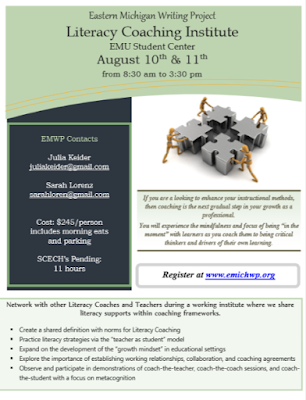
Literacy Coaching Institute

EMU Student Center
August 10th & 11th; 8:30 am to 3:30 pm


Network with other Literacy Coaches and teachers during a working institute where we share literacy supports within coaching frameworks.


If you are looking to enhance your instructional methods, then coaching is the next gradual step in your growth as a professional. You will experience the mindfulness and focus of being “in the moment” with learners as you coach them to being critical thinkers and drivers of their own learning.

Click here for more information on the institute and how to register.
Read more!

EMWP teachers, Inkstains Summer Writing Camp needs your help with student referrals!

Aimee Grant

Each year, scores of our middle and high school campers hear about Inkstains because their teachers put a brochure in their hand and a recommendation in their ear. Can you please be that teacher? You can help connect your students who love to write with other like-minded kids to spend a week doing what they love – filling up a marble composition book, trekking across campus on a writing marathon, and making year-long connections with their camp buddies.


Our middle school camp is for incoming grades 6-8 and runs from July 6-10; the high school camp is for incoming grades 9-12 and runs from July 13-17.

The application deadline is June 15, 2015. Applications require a teacher letter of recommendation, but EMWP teachers are permitted to send a short email recommendation to Kim Pavlock at kpavlock@emich.edu .

You can find our camp brochure here: http://emichwp.org/wp/inkstains-writing-camp/.

Thank you for your help spreading the good news about Inkstains!
Read more!

Our Students’ Gifts to Us

Jim Schaefer

One of the very nice things about teaching is that frequently what students write at the end of a semester can lift your spirits as a teacher. That happened to me this semester, which had been a very difficult and demanding time for various reasons.

My epiphany happened as I was grading papers for the last full week of classes. I ask each student to write what I call a “portfolio” journal about what she or he learned during the semester.


What one student wrote in her journal was what I regard as a gift to me because it was so insightful. Her very first sentence caught my attention when she said, “Both semesters I have shared with you have each taught me a lot, not only about my writing but my character as well.” That was wonderful, but then she went on about how the essays that she wrote in her class showed her “that I am capable” of doing that.

Even more interesting to me, she shared how she had decided to write letters to loved ones when she was “feeling emotional.” That didn’t always work out well, but she was pleased that she was able to express herself and share her thoughts, where before that, she would stay silent. She ended her journal by saying that the “most important thing” that she learned was “that I am capable of taking my writing to any level I put my mind to.” Her final sentence was, “Thank you for sitting me down and letting me be me.”

Those kinds of thoughts from a student make all the struggles worthwhile, indeed. They are gift, authentic and genuine.
Read more!

Professional Development Updates (Part 3 of 3)
For All Those Data-Lovin’ Hearts...


Sarah Lorenz

Read Part 1
Read Part 2

So the first task is to see if the PD is hitting the target and meeting teachers’ needs. If that isn’t happening, it’s unlikely we’ll see changes in practice and student outcomes. If feedback is positive, the next step will be to see if there are changes in teacher practice. I have two possible data collection points for this: coaching data and assignment quality data. If coaching is being used in some form, the coach and coachee can track the type of work they are doing by coding their coaching sessions. This can be done anonymously, to protect teacher privacy, by the coach giving a teacher a number. As teachers begin to implement more deeply, the coding should show a progression—from talking about a practice to experimenting with a practice, to implementing a practice, to innovating with a practice.

This type of data has the potential to assure administrators that teachers are indeed working with the practices, hopefully progressing in sophistication, and that ongoing support is warranted. This method uses the Instructional Coaching Scale, which is readily found online. I believe that it can be adapted for peer coaching or PLCs, as well.

The Assignment Design Framework from the National Writing Project is another method for tracking changes in practice. At one of our partnership schools, I assisted teachers in learning about this framework and how it helps us plan writing assignments for intellectual depth and rigor. (NWP also has a tool for assessing the quality of a writing assignment, based on this work, which came from Fred Newmann and the Chicago Schools Consortium.) Teachers then planned a joint writing assignment for 9th graders and administered it during semester one. They brought student work from the assignment, and we assessed both student work and the teacher assignment. We noted places where the assignment could be improved to generate better student work, and then planned a new assignment for semester two. This assignment was vastly better than the first, we all agreed. The scope became much larger, but we also noticed how many of the CCSS we addressed, simply as a by-product.

Finally, assessing student writing is a fourth way of collecting data. We will ultimately be looking at scores on standardized tests, but teachers often benefit more by gathering student work and analyzing it together. We can use any rubric to do this, but the National Writing Project’s Analytic Writing Continuum, a research tool based on the Six Traits model, is particularly useful. A formal scoring session is possible, but many school don’t have the time or resources to do this. In a more informal session, I typically ask teachers to bring some student samples of low, medium, and high writing. We can first work together with one sample and learn how to score, then everyone can individually score 5 or 10 of their own papers, looking for trends. The discussion often shifts immediately to instruction—how can we support the changes we want to see?

We will be implementing more of these data-collection techniques in the current school year. My hope is to encourage the healthy use of data, in ways that support teachers and deepen their practice. I welcome your feedback and ideas from your schools and practice during this exploration.

Sarah Lorenz
sarahloren@gmail.com

*Some of this work has been informed by the SEED grant that EMWP participated in with the National Writing Project over the past two years. We coordinated a year of intensive professional development (over 40 hours, in multiple modes such as workshop, model lessons, coaching, looking at student work, etc.) in two elementary schools and collected various types of data. These included teacher perception data as well as formal outside evaluation of student writing. Participation in projects such as this are part of the capacity-building cycle of NWP: our site gains funding and valuable skills, while we support the ability of NWP as a whole to gain competitive grant funding and recognition for our work.
Read more!